
Chase County Criminal Case Files
A criminal court record in Chase County is the court case file, not just a charge label. The District Court maintains the file after charges are filed by the prosecutor. It can contain the complaint, probable-cause material if public, bond orders, first appearance entries, plea papers, hearing notices, motions, trial settings, sentencing orders, journal entries, probation terms, revocation motions, and disposition information. The Clerk of the District Court is the records office for those files.
Chase County is in the 5th Judicial District. The District Court sits at the Chase County Courthouse, 300 Pearl, P.O. Box 529, Cottonwood Falls, KS 66845. Jenna Gibb is listed as Clerk of the District Court, and the office phone is 620-273-6319. Criminal records can involve the local district magistrate judge, district judges connected to the 5th Judicial District, the County Attorney, court services, sheriff records, and statewide systems, but the court case file itself stays with the court.
Search Chase County Criminal Records
Start with Kansas CaseSearch for public district court case information. If the case or document is not available online, use the courthouse terminal or contact the Clerk of the District Court for copies, certified copies, and restricted-file questions. The 5th Judicial District docket page can help with upcoming hearings, but a docket calendar is not the full criminal court record.
- Search by defendant name or case number in CaseSearch.
- Confirm the court as Chase County District Court or the 5th Judicial District when filters are available.
- Read the docket entries for charges filed, first appearance, bond, motions, plea, disposition, and sentencing.
- Use the 5th Judicial District docket PDF only to confirm upcoming hearing dates.
- Request copies or certified copies from the Clerk of the District Court when online entries are not enough.
For a closer look at the charges themselves, including amended, reduced, dismissed, or diverted charges, see the Chase County arrest records and court charges material. The criminal court record remains the broader case file and outcome record.
Chase County Criminal Case Flow
A criminal case can begin with an arrest, citation, warrant, or law-enforcement referral. The County Attorney decides whether to file a complaint, amend charges, dismiss counts, offer diversion, negotiate a plea, seek revocation, or appear at sentencing. Once the case is filed, the court record tracks each public event from first appearance through the final outcome.
Case flow: Charges Filed › Arraignment › Pretrial and Motions › Plea or Trial › Disposition › Sentencing
| Stage | What the Criminal Record May Show |
|---|---|
| Charges filed | Complaint, count numbers, alleged offenses, severity, filing date, prosecutor, and court case number. |
| Arraignment or first appearance | Initial hearing, plea entry where applicable, bond terms, counsel status, and next setting. |
| Pretrial and motions | Discovery, motions, continuances, preliminary hearing settings, warrant entries, and status hearings. |
| Plea or trial | Guilty, not guilty, no contest, trial setting, verdict, dismissal, diversion, or amended charges. |
| Disposition | Outcome for each count, including conviction, dismissal, acquittal, diversion, or other final action. |
| Sentencing | Jail, prison, probation, fines, fees, restitution, supervision terms, and later revocation entries. |
County Attorney Criminal Records Role
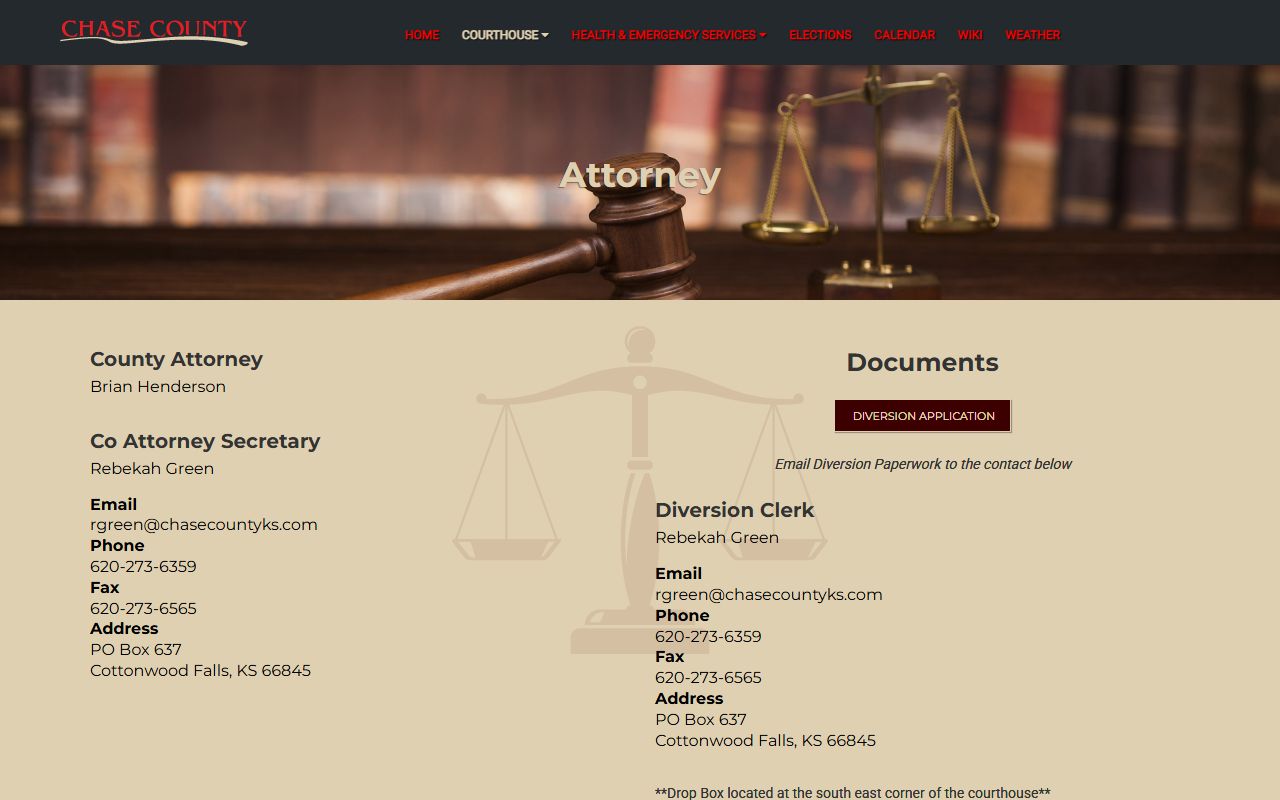
Brian Henderson is listed as Chase County Attorney. The County Attorney page lists Secretary and Diversion Clerk Rebekah Green, email rgreen@chasecountyks.com, phone 620-273-6359, fax 620-273-6565, and P.O. Box 637, Cottonwood Falls, KS 66845. The page links a Diversion Application and states diversion paperwork should be emailed to the listed contact. That office handles prosecution and diversion materials, while the Clerk of the District Court keeps the court file and certified court copies.
Diversion is not the same as an acquittal or a conviction. It is a prosecutor-supervised path that may avoid conviction if conditions are completed. If diversion appears in a Chase County criminal court record, read the docket entries and any public orders carefully. The charge may remain part of the case history even when the final result is not a conviction.
The official Chase County Attorney page identifies the prosecutor and diversion contact.
Chase County Criminal Record Fields
Reading a Chase County criminal court record requires field-by-field care. The case status may be pending, disposed, dismissed, diverted, transferred, sealed, restricted, inactive, or closed. A case can have several counts, and each count can have a different outcome. The docket may also show bond, revocation, probation, restitution, or payment events after the main plea or sentencing date.
| Field | What It Shows |
|---|---|
| Case number | The exact identifier used in CaseSearch, dockets, clerk requests, and payment records. |
| Defendant | The person charged in the court case, with public identifiers subject to redaction. |
| Charge or count | The alleged offense filed by the prosecutor, including count number and statute or ordinance if shown. |
| Bond | Money or conditions set to secure release and appearance, including later modifications. |
| Hearings | Date, time, judge, hearing type, continuance, review, trial, plea, or sentencing setting. |
| Plea | Guilty, not guilty, no contest, or other plea event shown in the docket or order. |
| Disposition | Outcome for a count or case, such as conviction, dismissal, acquittal, diversion, or judgment. |
| Sentence | Jail, prison, probation, fines, costs, restitution, supervision, or conditions imposed after conviction. |
| Documents | Complaints, motions, orders, warrants after public availability, journal entries, and sentencing papers. |
Charges vs Convictions
A charge is an accusation filed in court. A conviction is a finding or plea of guilt entered by the court. Chase County criminal court records may show charges that were later amended, dismissed, reduced, diverted, or resolved by plea. That is why a case should be read through disposition and sentencing, not stopped at the first charge line.
| Point | Charge | Conviction |
|---|---|---|
| Meaning | Formal accusation after arrest, citation, or referral. | Guilty plea, no-contest plea treated by the court, or guilty verdict. |
| Timing | Appears near the start of the case. | Appears after plea, trial, or other final action. |
| Can change | May be amended, reduced, dismissed, or diverted. | May be appealed, corrected, revoked, or later expunged if eligible. |
| How to verify | Read the complaint and later docket entries. | Read disposition, journal entry, sentencing order, and count-level outcome. |
Sealed vs Expunged Records
Juvenile matters, adoption records, some care and treatment files, sealed records, and expunged criminal records are not ordinary public records. Even public criminal cases can have redacted SSNs, birth dates, protected addresses, minor names, financial data, medical details, victim-specific information, or sealed affidavits. CaseSearch and courthouse terminals should not expose sealed material to the general public.
| Point | Sealed | Expunged |
|---|---|---|
| Public visibility | Hidden from ordinary public access by court order or law. | Public access is limited after a qualifying expungement order. |
| Record status | The record still exists but is restricted. | The record is not destroyed for every legal purpose. |
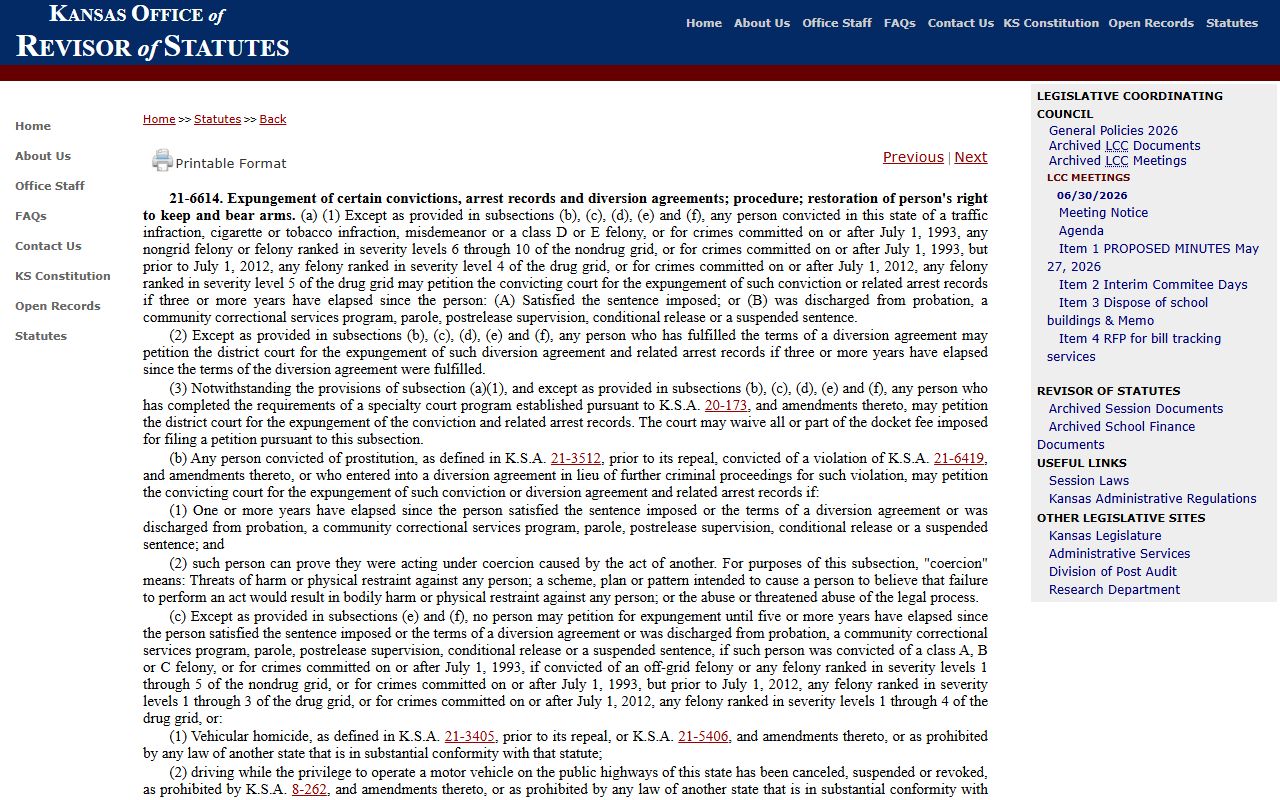
| Kansas path | Depends on the case type, order, and access rule. | K.S.A. 21-6614 allows petitions for certain convictions, arrest records, and diversion agreements. |
| Where to ask | Clerk of the District Court. | Convicting court or the court that handled the qualifying case. |
Kansas expungement rules are published at K.S.A. 21-6614.
Chase County Criminal Records Access
Kansas public access for criminal court records is shaped by KORA principles, Kansas Supreme Court Rule 22, and court procedures. Public case information may be available through CaseSearch, but electronic access does not mean every document is online. A courthouse terminal may provide access to records not visible from home, and certified copies must come through the clerk.
Do not confuse court records with prison, supervision, or registered offender databases. KDOC is useful for sentenced state-prison residents or supervised populations. KASPER information is updated each working day, according to the official disclaimer and locating FAQ. The KBI registered offender website covers persons required to register under Kansas law. Those statewide systems can be relevant after a conviction, but they are not the Chase County criminal court case file.
The Kansas Department of Corrections homepage provides navigation for state corrections information.

Criminal Court Terms in Chase County
Short definitions can prevent common mistakes when reading a Chase County criminal court record.
- Complaint
- A charging document that starts or supports a criminal case.
- Arraignment
- A hearing where charges are formally addressed and a plea may be entered.
- Disposition
- The outcome of a charge or case, such as conviction, dismissal, diversion, or acquittal.
- Bond
- Money or release conditions set to secure the defendant's return to court.
- Revocation
- A court action to withdraw probation, bond, or diversion after an alleged violation.
Public Record Search
Sponsored Results