
Chase County Clerk Records
Jenna Gibb is listed by the county and the 5th Judicial District as the Chase County Clerk of the District Court. This office maintains district court case records and supports public access to the court record system. It is the correct starting point for civil, criminal, probate, divorce, small claims, limited action, juvenile-access questions, copies of pleadings or orders, certified court copies, and courthouse terminal access.
The Clerk of the District Court is located with the Chase County District Court at 300 Pearl, P.O. Box 529, Cottonwood Falls, Kansas 66845. The phone number is 620-273-6319, fax is 620-273-6890, and listed hours are Monday through Friday, 8:00 a.m. to 5:00 p.m. The courthouse has a drop box at the southeast corner, but time-sensitive court filings should be confirmed with the clerk before using it.
Clerk of the District Court
Clerk: Jenna Gibb
300 Pearl, P.O. Box 529
Cottonwood Falls, KS 66845
620-273-6319
Fax: 620-273-6890
Monday-Friday, 8:00 a.m.-5:00 p.m.
District Clerk vs County Clerk
Chase County uses a split record model. The Clerk of the District Court handles court case files. The County Clerk/Election Officer is a separate county administrative office. The county page names Connie Pretzer as County Clerk/Election Officer, elected 2016, and Tiffany Harshman as Deputy County Clerk/Deputy Election Officer. The County Clerk's office uses phone 620-273-6423, P.O. Box 529, Cottonwood Falls, Kansas 66845, and 8:00 a.m. to 5:00 p.m. Monday through Friday hours.
The County Clerk page is important for Kansas Open Records Act requests involving county administrative records. It publishes the local KORA summary and links an open records request form. It also lists county functions such as homestead refund filings, property tax levy information, Kansas Wildlife and Parks licenses and permits, accounts payable warrant registers, monthly interim reports, employment links, vital-statistics links, and a notary public. Those are not district court case-file functions.
The separate County Clerk source is shown in this image from the Chase County Clerk's Office page.
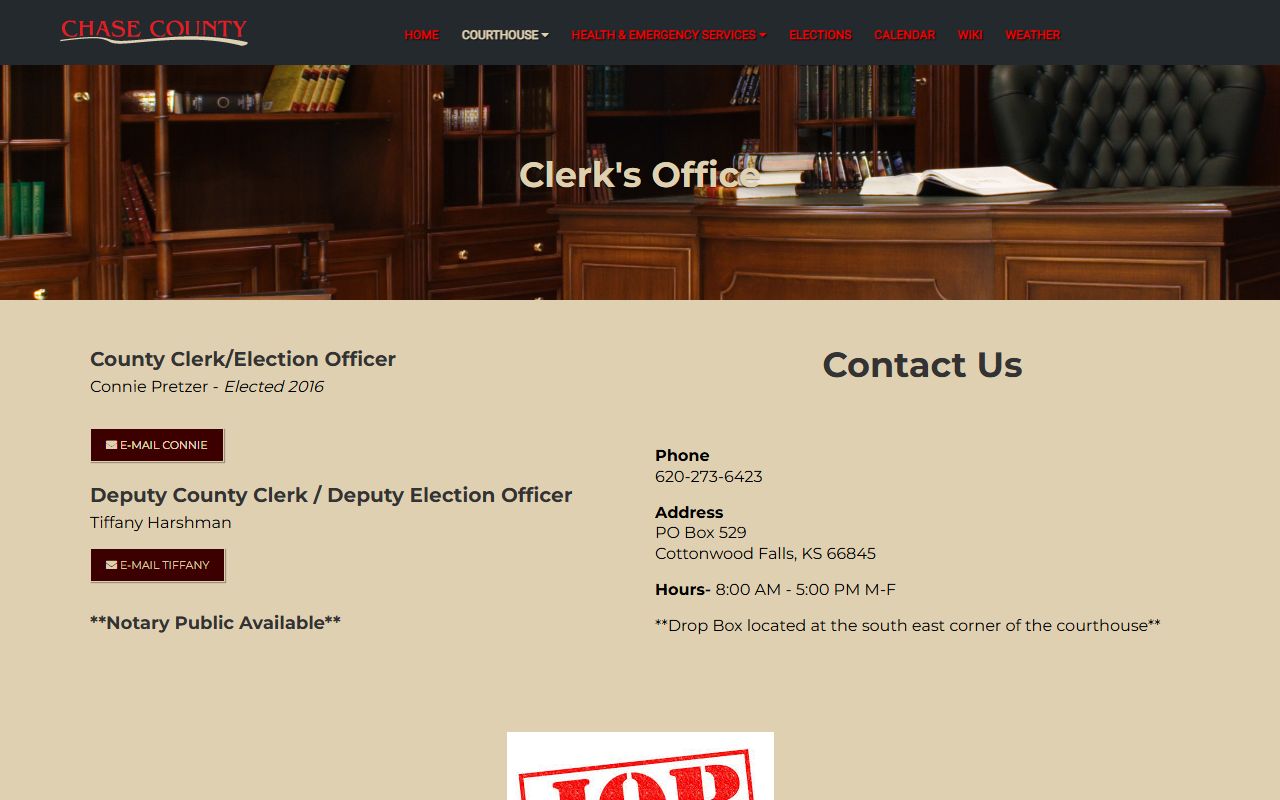
The image reinforces the office split: county administrative records and KORA forms are not the same as district court case copies.
Chase County Court Copy Duties
The district clerk's practical role is to connect the public, litigants, attorneys, and court staff to district court records. The office handles case-file access questions, copy requests, certification needs, older file questions, and routing for records that do not appear in public internet search. The clerk can also confirm how to use the courthouse terminal for public court records and when a document is restricted, sealed, or unavailable without a court order.
- Civil, limited action, and small claims case records.
- Criminal, traffic, bond, plea, disposition, and sentencing entries filed in district court.
- Probate, estate, guardianship, conservatorship, divorce, domestic, and child-support case records.
- Certified copies of court orders, decrees, journal entries, and other eligible documents.
- Courthouse terminal access and records not available through public internet search.
- Access questions for juvenile, sealed, expunged, adoption, or restricted filings.
Request Chase County Certified Copies
A certified court copy is used when an agency, employer, court, title company, school, or benefits office needs proof that a court document is a true copy from the case file. Common Chase County requests include divorce decrees, probate orders, letters testamentary, judgments, criminal dispositions, name-change orders, and small claims judgments. Certification is different from a plain printout or an online case summary.
- Identify the case number from Kansas CaseSearch, a docket notice, a citation, a prior order, or clerk assistance.
- Write the party names, case type, document title, approximate filing date, and whether certification is needed.
- Call the Clerk of the District Court at 620-273-6319 to confirm availability, fee, payment method, and pickup or mailing options.
- Submit the request in person, by mail to P.O. Box 529, or by another method the clerk confirms.
- Use the courthouse terminal or clerk counter if the record is public but not available online.
- For restricted records, ask what proof, party status, attorney authority, or court order is required.
Note: Official Chase County online sources did not publish a full court-copy fee schedule, so fees should be verified before mailing payment.
Chase County Request Fields
No dedicated Chase County court-copy request PDF was located in the official online sources reviewed. A useful clerk request still needs enough detail to identify the file and the exact document. For county administrative KORA requests, the County Clerk page links a downloadable KORA form and states the county response rule. For district court copies, use court-record details rather than a generic county KORA request when the target record is a case file.
| Field | Required / Useful | Notes |
|---|---|---|
| Case number | Useful | Best identifier for district court copy requests. |
| Party names | Yes | Use names as they appeared in the case caption. |
| Record type | Yes | State whether the request is civil, criminal, divorce, probate, traffic, or small claims. |
| Document title | Yes | Examples include decree, journal entry, order, disposition, judgment, or letters. |
| Certification need | Yes | Say whether a certified copy is required. |
| Contact information | Yes | Include phone, email, and mailing address for fee and delivery questions. |
| Payment method | Confirm | Ask the clerk what payment types are accepted for the specific request. |
Chase County Clerk Fees
The official research found some Chase County court-related fees, but not a complete district court copy and certification schedule. Use the located figures only for the services they describe. Do not treat a small claims fee or marriage license fee as a general court-copy fee. The district court page also states that online court payments through the linked payment option carry a 4% convenience fee for credit or debit card payment.
| Item | Amount / Method |
|---|---|
| District court online payment convenience fee | 4% for credit/debit card payment through linked court payment page |
| Small claims filing fee up to and including $500 | $47.50 |
| Small claims filing fee $500.01 to $10,000 | $67.50 |
| Small claims sheriff service fee | $15.00 per address served, separate check or money order |
| Witness subpoena fee | $10.00 witness fee plus mileage; sheriff service may apply |
| Small claims appeal filing fee | $195.00 |
| Marriage license | $85.50 plus $2.14 card fee for credit/debit payment |
| Court copy or certified-copy fees | Not located in official Chase County online sources; call 620-273-6319 |
Chase County Clerk Forms
The 5th Judicial District forms page links Kansas Judicial Council legal forms, self-represented litigant forms, 5th Judicial District drug court forms, and a pro se eviction packet. Chase County small claims has a local 5th Judicial District page with filing requirements, fees, sheriff service fee, hearing process, judgment collection steps, and appeal information. The County Attorney page links a diversion application, but diversion paperwork goes to the prosecutor contact, not to the district clerk as a copy request.
The local small claims source is shown in this image from the 5th Judicial District Chase County small claims page.
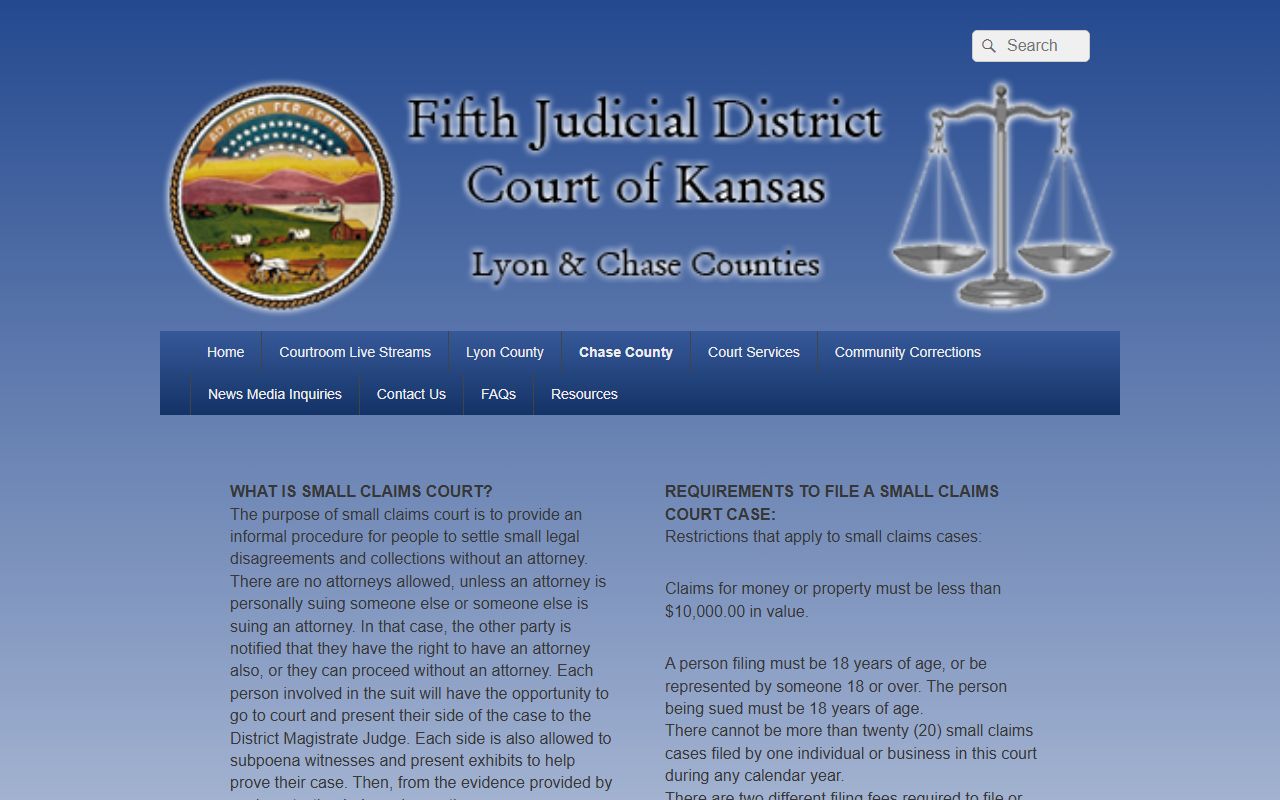
Small claims is useful on the clerk page because it supplies several verified Chase County court fees and filing-process details.
Other Chase County Record Offices
The Register of Deeds is led by Kathy J. Swift and records deeds, mortgages, oil and gas leases, easements, platted additions, financing statements, and real-estate fixture filings. That office is the right source for recorded land instruments, including property records tied to estate transfers, but not for district court pleadings. The County Attorney, Brian Henderson, handles prosecution and diversion matters, with Rebekah Green listed as diversion clerk. Diversion applications and prosecutor contact are not district court copy requests.
The Treasurer page is a separate county office source. It covers driver-license renewal details, tax and motor vehicle roles, treasurer and deputy names, office hours, and the drop box. The Treasurer is not the Clerk of the District Court, but it is part of the courthouse record landscape and helps show why office routing matters in Chase County.
The Treasurer office source is shown in this image from the Chase County Treasurer page.
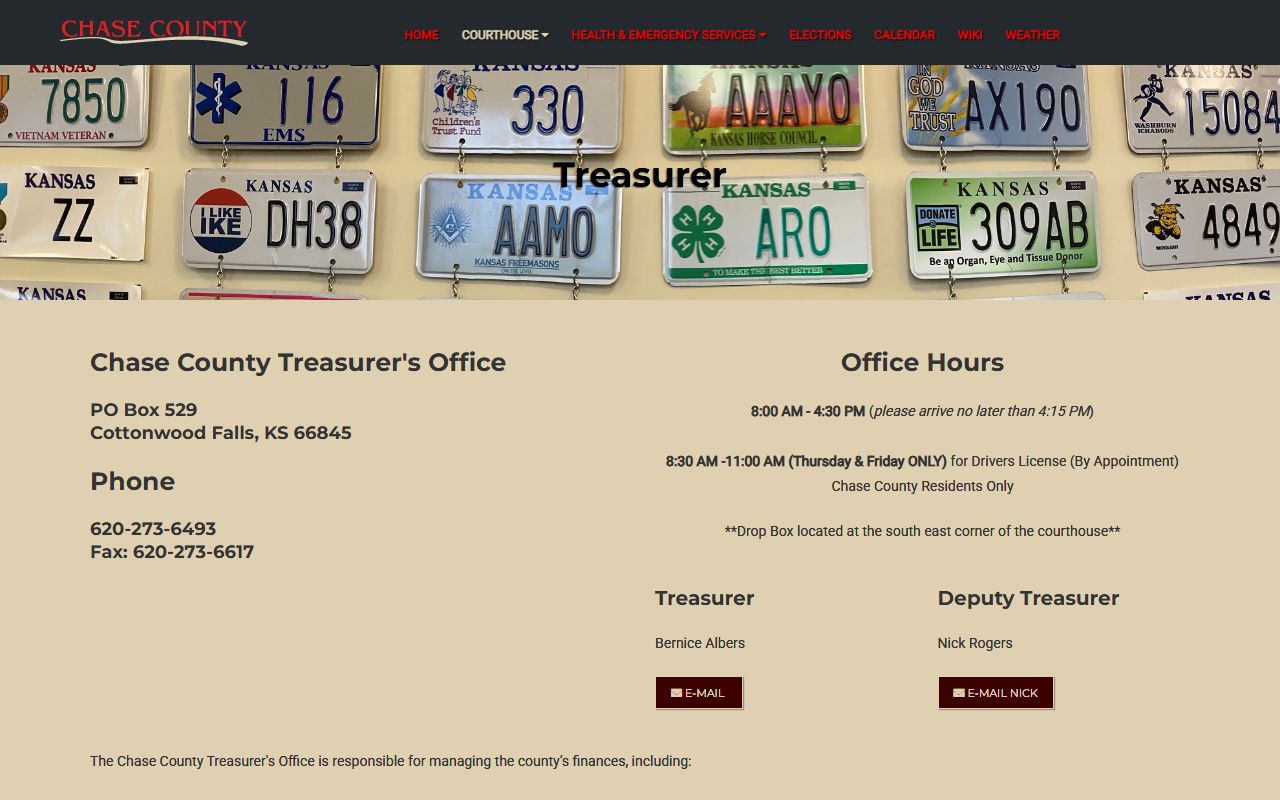
Use the Treasurer for tax, motor vehicle, and driver-license renewal items, not for certified court records.
Federal Clerks Are Separate
Federal court records are separate from Chase County District Court records. The U.S. District Court for the District of Kansas uses federal CM/ECF and PACER systems, and PACER is the federal judiciary's paid electronic access system. A state Chase County criminal, civil, probate, traffic, small claims, or divorce file will not be in PACER unless a separate federal case exists or a case is removed to federal court.
The federal lookup distinction is shown in this source image from the PACER CM/ECF court lookup page.
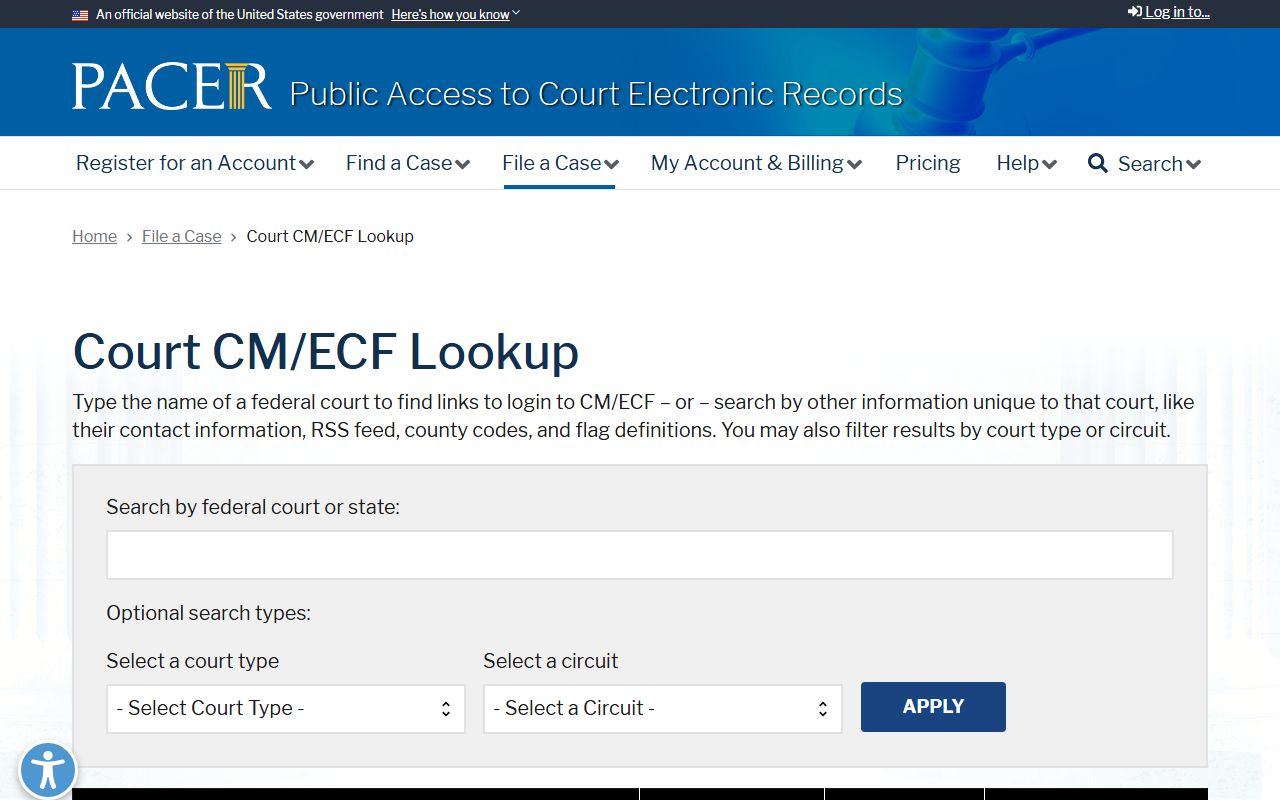
PACER belongs in the federal records path. Chase County District Court records still route through Kansas CaseSearch, the courthouse terminal, and Jenna Gibb's office.
KORA and Chase County Court Access
The County Clerk page summarizes the Kansas Open Records Act by stating that public records are open unless closed by law and that, within three business days, a county department must provide records, state when and how and at what cost they will be provided, or state why records cannot be provided. That process is important for county administrative records. It is not the best first step for district court case files.
For court files, use Kansas CaseSearch, the courthouse terminal, and the Clerk of the District Court. For county administrative records, use the County Clerk's KORA form. For land records, use the Register of Deeds. For criminal charging or diversion paperwork, use the County Attorney. For sheriff incident reports or jail records, use Sheriff/911. Matching the custodian saves time and avoids sending a valid request to the wrong office.